Last modified on
January 29, 2024
by
Eileen Stuyniski
Overview
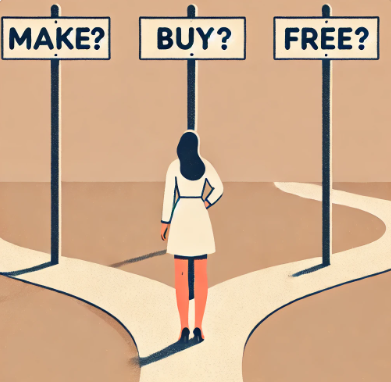
This article provides instructional material alternatives, with examples, for use in online, hybrid, and in-person courses. Three options will be considered. Should you “make”, “buy” or look for “free” materials that support your learning objectives?
Making Your Own Instructional Materials
Consider making your own instructional materials to meet the specific needs of students. There are pros and cons to creating custom materials. One significant advantage is the ability to tailor materials specifically for your students and learning objectives. Additionally, sharing these materials with a larger community is possible, potentially through a Creative Commons license. However, the time it takes to develop thoughtful, focused, and relevant learning materials can make it prohibitive in some cases. Examples of instructional materials that can be made independently:
Presentations
- PowerPoint (Microsoft 365. UConn supported)
- Keynote (Apple)
- Canva (Presentation Design)
- VoiceThread (UConn supported)
- UConn Lightboard Technology (Written or Visual Demonstrations for Instructional Videos. UConn supported)
Images
- Canva (Infographics/Posters/Banners)
- Piktochart (Infographics)
- Unsplash (Photos)
- See UConn eCampus Knowledgebase article, Finding and Using Free Images, for additional image sources.
Videos
- YouTube (Free Video Sharing website)
- Vimeo (Free Video Hosting platform)
- Kaltura (UConn supported video platform)
- Vyond (animated videos; need to purchase license)
Audio
- VoiceThread (Interactive Slideshows)
- Audacity (Free Audio Recorder)
Text
- Instructor Notes
- Instructor-created handouts
Buying Instructional Materials
Consider the various options for purchasing materials, though be mindful that the cost is often passed on to students. Traditionally, college courses are associated with buying textbooks, but with the abundance of online resources (from government websites to open educational resources), reconsider if purchasing is necessary. Before deciding to ask students to buy materials, reflect on the following:
- Is there a comparable, high quality substitute that is readily available at a lower cost or for free?
- Can negotiation with the publisher reduce costs for students?
- Can students achieve the learning objectives without purchasing materials?
If the answer to any of these questions is yes, explore low or no-cost alternatives.
As of Spring 2023, the UConn Board of Trustees approved the Barnes & Noble First Day Complete Program, also known as the Husky Book Bundle Program, charging UConn undergraduate students a $285 per semester fee for textbooks and course materials. In return, students receive all required materials for registered courses at no additional cost from the bookstore. This program aims to help reduce the cost of course materials for students. All full-time undergraduate students are eligible and automatically enrolled in the Husky Book Bundle program. Students not wishing to participate must “opt out” before each semester begins. Here is more information on the Husky Book Bundle.
Looking for Free Materials
Remember the saying, “Why pay for something when it can be obtained for free?” Explore resources on Finding and Using Free Learning Materials and How to Cite Free Learning Materials in your Courses. For a high-quality, free textbook, check out the Open Textbook Library hosted by the University of Minnesota, Twin Cities, or visit UConn’s Open Educational Resources for Teaching and Learning, hosted by the UConn Library.2 Research indicates providing students with free access to various instructional materials enables better anticipation and response to the diverse backgrounds and skills students bring to class.1 Zero-cost materials also result in higher success rates, higher completion rates, and improved grades.3
Key Strategies for Ensuring Accessible Course Materials
When selecting instructional materials, accessibility must also be considered. This is a university requirement under the Americans with Disabilities Act, Section 504 of the Rehabilitation Act, and state law. Review these UConn IT Accessibility Key Strategies to Develop Accessible Course Materials web resources and this UConn eCampus Accessibility Checklist and Guide to ensure your materials are accessible to all students.
Additional Resources
Related Resources
- Quality Matters Rubric: General Standard 4. Instructional Materials
- Open Education (UConn Library)
Related Posts
References
- University of Minnesota Open Textbook Library
- UConn Library Open Education
- Shalabi, L. (2021, March 1). Survey: Textbook costs having greater impact on students during pandemic. WUSF.