Last modified on
December 20, 2024
by
Eileen Stuyniski
Overview
This article explains rubrics, types of rubrics, outlines how rubrics may benefit both faculty and students, and provides a few HuskyCT example rubrics.
What is a rubric?
A rubric is a learning and assessment tool that articulates the expectations for assignments and performance tasks by listing criteria, and for each criteria, describing levels of quality from excellent to poor (Andrade, 2000; Arter & Chappuis, 2007; Stiggins, 2001). The clarity of rubrics is the most important characteristic for its comprehension and application (Al-Rabai, 2014). Rubrics contain three essential features (Stevens & Levi, 2012):
- a scale (and scoring) that describes the level of achievement (e.g., exceed expectation, meets expectation, does not meet expectation);
- components/dimensions/criteria students are to attend to in completing the assignment/tasks (e.g., types of skills, knowledge, etc.); and
- description of the performance quality (performance descriptor) of the components/dimensions at each level of mastery.
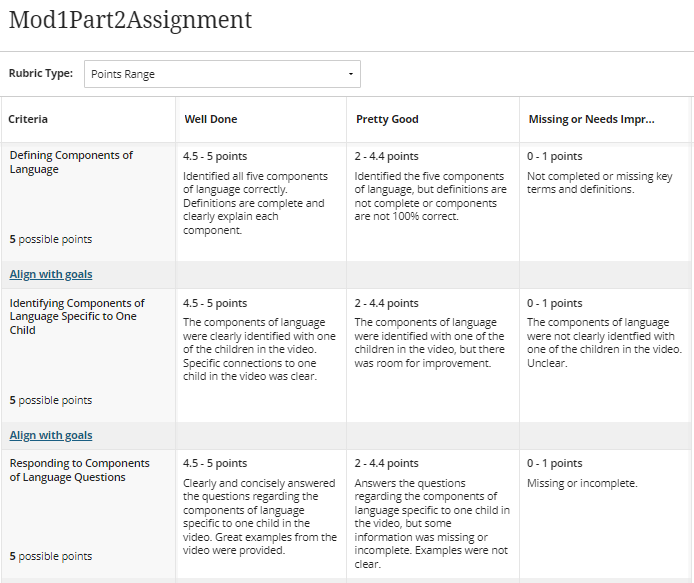
Open this example rubric to see these three essential features outlined above:
Rubric Types
There are three different basic types of rubrics:
- Analytic Rubrics resemble a grid with criteria in the leftmost column and levels of achievement across the top row of the grid. These types of rubrics identify and assess “components” of a finished product.
- Holistic Rubrics are more general and consist of a single scale that contains all criteria to be included in the evaluation. These types of rubrics assess the finished product as a “whole”.
- Single Point Rubrics can be simpler, easier, and faster to create and read since they have only one single column of criteria, rather than multiple performance levels. These type of rubrics allow for higher quality feedback since faculty must document both the student’s strengths and opportunities in writing.
Note: The Basics of Rubrics from Penn State University Schreyer Institute for Teaching Excellence does a nice job of clarifying analytic and holistic rubric types. Meet the Single Point Rubric from the Cult of Pedagogy provides a nice overview of single point rubrics.
Rubric Benefits
How do rubrics benefit students?
- Clarify Expectations: Rubrics demystify grading by clearly stating a coherent set of criteria for performance (from excellent to poor) as well as detailed descriptions of each level of performance.
- Improve Learning: Students report rubrics help them with learning and achievement. Students can use rubrics to focus their efforts and self-assess their own work prior to submission.
- Encourage Feedback and Reflection: Rubrics provide students with specific feedback and allow students to reflect on their performance in order to improve.
Note: Rubric Best Practices, Examples, and Templates from North Carolina State University discusses the importance of using parallel and student-friendly language when creating rubrics. This resource also links to many example rubrics.
How do rubrics benefit faculty?
- Save Time: Rubrics help faculty save time grading since uncertainty is reduced and the detailed descriptions for levels of achievement free the instructor from writing out long comments.
- Provide Consistency Among Multiple Graders: Large courses may use multiple graders (Co-instructors, Teaching Assistants, etc.). Creating and using a common rubric may help to ensure more consistency among graders.
- Reduce Bias: Rubrics help make grading more transparent and fair.
- Justify Grading: Rubrics document why faculty awarded certain grades. Grading history is maintained.
- Weigh Importance: Since some assignment criteria is more important than others, rubrics allow instructors to “weigh” the criteria in order of the importance of the objectives of the assignment.
Example UConn HuskyCT Rubrics:
This Rubric Examples Word Document contains some examples of analytic rubrics you may want to use as a starting point for creating various HuskyCT (Blackboard) rubrics for your course.
Additional Resources
Related Resources
- Create or Generate Rubrics (Blackboard Help Center)
- Taylor, B., Kisby, F., & Reedy, A. (2024). Rubrics in higher education: An exploration of undergraduate students’ understanding and perspectives. Assessment & Evaluation in Higher Education, 49(6), 799–809.
- Ragupathi, K., & Lee, A. (2020). Beyond fairness and consistency in grading: The role of rubrics in higher education. In C. S. Sanger & N. W. Gleason (Eds.), Diversity and inclusion in global higher education: Lessons from across Asia. Palgrave Macmillan.
- Weimer, M. (2013). Should you be using rubrics?. Faculty Focus.
- Weimer, M. (September 9, 2015). Exploring the Advantages of Rubrics. Faculty Focus.
- Reddy, Y. M., & Andrade, H. (2010). A review of rubric use in higher education. Assessment & Evaluation in Higher Education, 35(4), 435–448.
- Thakore, B. K. (2024). Doing sociology, learning objectives, and developing rubrics for undergraduate research methods. Teaching Sociology, 52(1), 66–74. (Note: This article was written by Bhoomi Thakore, a UConn sociology faculty member.)
References
- Al-Rabai, A. (2014). Rubrics revisited. International Journal of Education and Research, 2(5), 473–484.
- Andrade, H. G. (2000). Using rubrics to promote thinking and learning. Educational Leadership, 57(5), 13-18
- Arter, J., & Chappuis, J. (2007). Creating & recognizing quality rubrics. Pearson.
- Center for Teaching and Learning. (n.d.). Assessment rubrics. UC Berkeley.
- Stevens, D. D., & Levi, A. (2012). Introduction to rubrics: An assessment tool to save grading time, convey effective feedback, and promote student learning (2nd ed.). Stylus Publishing.